
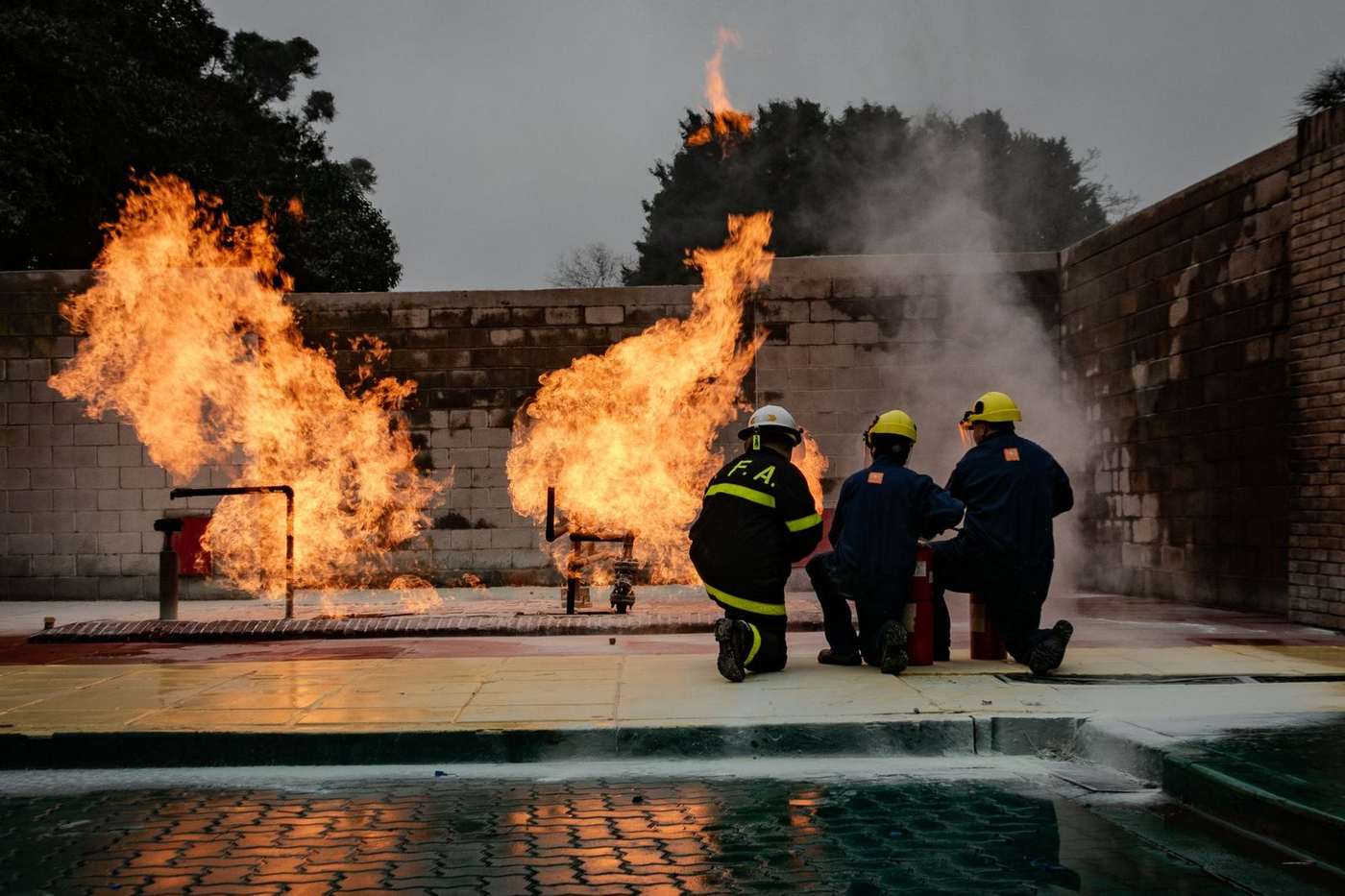
Fire Fighting
Basic fire prevention, extinguisher use and emergency evacuation.
Most workplace fires start small. Whether they stay small depends on the first person who sees it. This course teaches fire behaviour, correct extinguisher selection, and when to walk away.
Why this training matters
Almost every serious workplace fire was a small fire first. What decides the outcome is usually the minute or two after somebody notices it, and that minute belongs to whoever happens to be standing there. It is rarely the safety officer and it is almost never the fire brigade.
The common failures are predictable. Somebody grabs the nearest extinguisher without checking whether it suits the fire class, and puts water onto an electrical fault or a fat fire, making it worse. Somebody fights a fire that was already past fighting, instead of closing the door and getting people out. Somebody raises the alarm late because they wanted to deal with it quietly first. None of those are courage problems. They are training problems.
This programme is deliberately short and practical. One day, most of it on your own floor, so that the people who work in the building know the extinguishers on their own walls, the exits from their own area, and the assembly point they are actually expected to reach.
What you will learn
- How fires start, spread and are classified
- Fire prevention and housekeeping controls
- Selecting the correct extinguisher for the fire class (A, B, C, D and F)
- Practical extinguisher use under supervision
- Hose reels and fixed equipment familiarisation
- Raising the alarm, evacuation procedure, assembly points and roll call
- When not to fight a fire
The legal requirement
Section 8 of the Occupational Health and Safety Act 85 of 1993 puts a general duty on every employer to provide the information, instruction, training and supervision needed to keep people safe at work. For fire, that general duty is given shape by the Environmental Regulations for Workplaces, 1987.
Regulation 9 of those regulations, headed fire precautions and means of egress, requires an adequate supply of suitable fire fighting equipment at strategic points, maintained in good working order. It requires at least two means of egress, situated as far apart as is practicable given the size and layout of the workplace and the number of people in it. Emergency escape doors must be hung to open outwards, and every exit must be kept clear and capable of being opened quickly and easily from the inside.
Equipment bolted to a wall is not a control on its own. It becomes one when the people nearest to it know which extinguisher matches which class of fire, how to operate it, and at what point the correct decision is to stop and evacuate. That is the gap this course closes.
Sources
- Occupational Health and Safety Act 85 of 1993, Department of Employment and Labour
- Regulations made under the OHS Act, including the Environmental Regulations for Workplaces, Department of Employment and Labour
Legislation is summarised for orientation and is not legal advice. Always check the current text of the Act and its regulations, or take advice.
Practical assessment
A written knowledge check, then an observed practical. Every delegate discharges an extinguisher themselves on a controlled fire tray. Watching somebody else do it does not count as competent.
Prerequisites
None. The programme is written for a general workforce, with no prior safety training assumed.
What is included
- Training manual
- PPE for the practical
- Practical assessment
- Certificate
Certification
Delegates who complete the programme and are found competent receive the IMJ and company certificate, valid for 2 years. Attendance registers and assessment records are handed over to your health and safety department for the training file.
Refresher and re-certification intakes are available before a certificate lapses. Tell us the expiry dates and we will schedule around them.
Fire Fighting questions
It comes out of your risk assessment and your emergency plan rather than a fixed ratio. The practical test is whether every shift and every area has enough trained people that nobody is far from one. We help you size it when we quote.
Yes. We bring the controlled fire tray, the fuel and charged extinguishers for the practical. You provide an open area at a safe distance from buildings, stock and traffic.
Yes. On-site training is scheduled around your shift pattern, including nights and weekends, so you are not pulling a whole crew off production at once.
We re-assess on the day where there is time. If a delegate still is not competent we say so and they do not get a certificate. Issuing one anyway would put your company in a worse position than having no certificate at all.
No, and the two work together. This course trains the individuals. A full evacuation drill tests the building and the plan. We can run the drill on the same visit if you want the alarm, the roll call and the assembly point tested while everybody is on site.
Book fire fighting training
Send us the courses, the number of delegates and where you are. We come back with a written quote within one business day.