
Every lift starts with a number: what does this weigh? Get that wrong and the load chart, the sling selection and the whole plan are built on it. Most overload incidents trace back to an estimate somebody made by eye.
Work it out rather than judging it
Where the mass is not marked, calculate it. Volume multiplied by the density of the material gives a defensible figure, and for most fabricated items the shape can be broken into rectangles and cylinders quickly enough to do on paper.
Steel is roughly 7 850 kg per cubic metre. Concrete is around 2 400. Water is 1 000. Those three cover a surprising amount of what gets lifted on an industrial site, and knowing them turns a guess into an estimate you can show somebody.
Then add what the eye leaves out: the slings, the shackles, the spreader beam, the water sitting in a vessel that was supposed to be drained, and mud frozen to the underside of a bucket.
Sling angles change the arithmetic
This is the part that surprises people. The load on each leg of a sling is not simply the mass divided by the number of legs. As the angle between the legs opens up, the tension in each leg rises, and it rises faster than intuition suggests.
A load well inside the crane's rated capacity can therefore put a sling leg past its own rated capacity, purely because the legs were set too wide. The crane is fine, the chart was read correctly, and the sling is the thing that fails.
Keeping included angles tight, or using a spreader beam to keep the legs closer to vertical, is what prevents that. It is also why sling angle is taught alongside load estimation rather than as a separate topic.
Centre of gravity decides how it behaves
Mass tells you whether you can lift it. The centre of gravity tells you what it will do once it leaves the ground. If the hook is not above the centre of gravity, the load swings to put it there, and it does so the moment it takes weight.
On an asymmetric load, that swing is the hazard: it moves the load sideways into whatever is nearby, including people. Working out where the centre of gravity sits, and rigging so the hook is over it, is the difference between a lift that goes straight up and one that has to be set back down and rigged again.
The legal frame around it
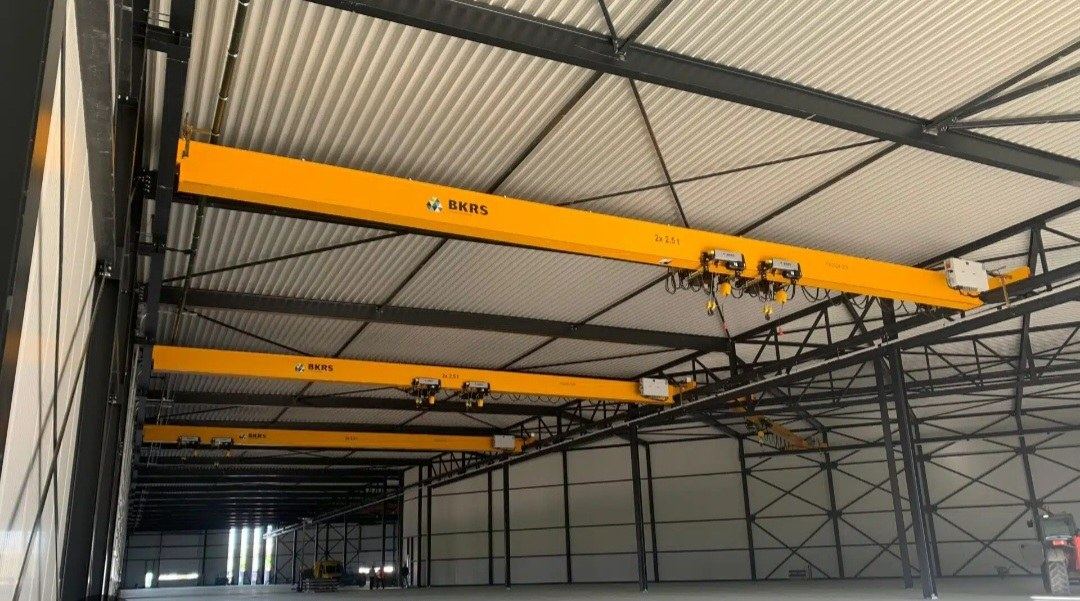
An overhead crane is a lifting machine and its slings and shackles are lifting tackle, both under regulation 18 of the Driven Machinery Regulations, 2015. Regulation 18(11) requires the machine to be operated by somebody specifically trained for that type of lifting machine, holding a certificate of training from a TETA accredited provider under the National Code of Practice for Training Providers of Lifting Machine Operators.
The duty falls on the user as well as the operator. Permitting an uncertified person to operate is the employer's contravention, not only the operator's.
Sources
- Driven Machinery Regulations, 2015, Department of Employment and Labour
Legislation is summarised for orientation and is not legal advice. Always check the current text of the Act and its regulations, or take advice.
Written by
Ian van Eeden
Director, IMJ OHS Compliance Training (Pty) Ltd
Ian van Eeden is a director of IMJ OHS Compliance Training and the person behind the training content published on this site. He works with mining and heavy industry clients across South Africa, and IMJ delivers its programmes at the client operation rather than from a classroom.